
How to Play the Word Chain Game With a Whole Group
Aug 13, 20265 min readJessica
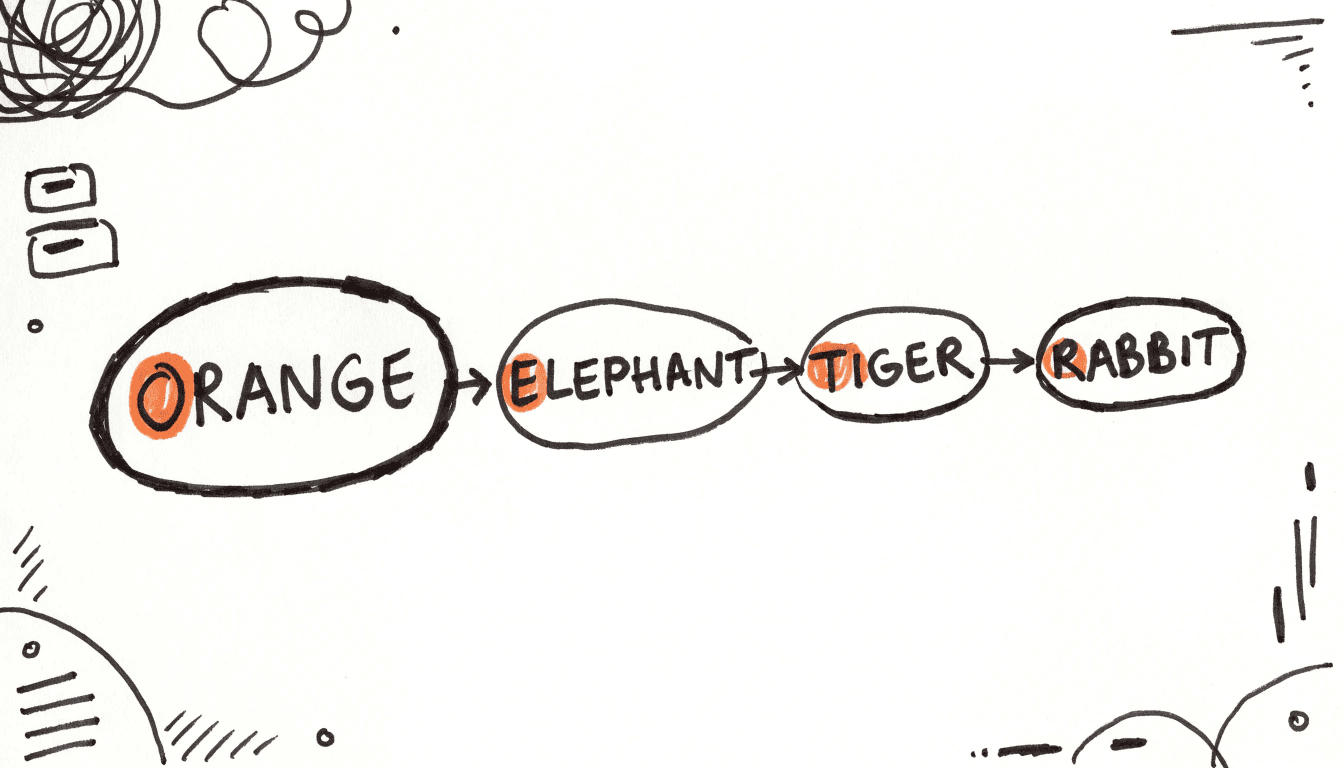
Everyone already knows this one. Someone says a word, the next person says a word starting with its last letter, and round it goes. Orange → elephant → tiger → rabbit. No board, no equipment, no explaining.
It’s one of the best group games there is, right up until there are more than about eight people in the room. Then it falls apart – and not because the game is bad. Because of one specific thing.
Here’s the game, the variations worth knowing, and how to run it for a room of forty without it dying on its feet.
The rules
- Someone says a starting word. Any word.
- The next person says a word beginning with the last letter of that word. Orange ends in E, so the next word starts with E.
- No repeats. Once a word is used, it’s gone for the rest of the round.
- A time limit per turn. Five or ten seconds is usual. Miss it and you’re out, or you lose a point.
- Last one standing wins, or highest score if you’re playing on points rather than elimination.
That’s the whole thing. It takes about fifteen seconds to explain, which is most of its appeal.
Why it breaks with a big group
The problem is turn-taking.
With six people, you get a turn every thirty seconds and you’re thinking the entire time. With thirty people, you get a turn every four minutes. For those four minutes you’re not playing – you’re watching, and probably looking at your phone. By the time it reaches you, you’ve lost the thread and half the room has quietly checked out.
There’s a second problem that only shows up at scale: nobody can remember which words have been used. With sixty words on the board, “no repeats” stops being a rule and starts being an argument.
Both problems have the same root. The classic game assumes one person plays at a time.
Four variations that fix it
Teams instead of individuals. Split into groups of four or five. Each team confers and answers as a unit, so everyone’s thinking on every turn. This alone takes it from eight players to about forty.
Categories. Restrict the chain to animals, cities, food, or anything else. Narrower options make it harder, and it gives quieter players a foothold – you don’t need a big vocabulary, you need to know a bit about one thing.
Two-letter chains. The next word must start with the last two letters of the previous one. Basket → etch → chair. A brutal step up, good for a group that’s already warmed up and getting smug.
Simultaneous play. Everyone answers at once rather than in sequence, and the chain resolves after each round. This is the one that actually solves the scale problem, and it’s the hardest to run without a screen – someone has to collect and check every answer at the same time.
Which version fits your group
| Group size | Best version | What you need |
| 3-8 | Classic, one at a time | Nothing |
| 8-20 | Teams of four or five | Someone to keep score |
| 20-40 | Teams + categories | A screen helps |
| 40+ | Simultaneous, everyone at once | A screen |
Where this fits in a session
A word chain is a strong opener, because there’s nothing to teach and no equipment to hand out – you can start it while people are still arriving and let latecomers slot in. It’s also a good palate-cleanser between two heavier activities, since it takes about five minutes and asks nothing of anyone.
It works particularly well with mixed-language groups and language learners. The mechanic is identical in any language, so the same game runs in English, Estonian, or Spanish without adapting anything – which is why it turns up so often in classrooms and ESL sessions.
Running it for a whole room
If you want the simultaneous version – everyone playing at once, no turn-taking, no arguments about repeats – you need something to hold the chain on a shared screen and check answers as they come in.
Word Loop is the hosted version of exactly this game. Each word has to start with the last letter of the one before, teams play from their own phones, and it scales to 25 teams. It works in any language, which makes it a genuine option for language classes and international rooms, and there’s nothing to learn – if someone knows the car-journey version, they already know how to play.
FAQ
What is the word chain game? A word game where each new word must begin with the last letter of the previous one. Orange → elephant → tiger. No repeats, and usually a few seconds per turn. It needs no equipment and takes seconds to explain.
How many people can play the word chain game? Three to eight works fine one at a time. Above that you want teams, and above about forty you want everyone playing simultaneously rather than in turn, or people spend more time waiting than playing.
Is the word chain game good for the classroom? Yes – it’s a common vocabulary and spelling exercise, and it works in any language, so it’s used a lot with language learners. Categories make it easier to pitch at the right level.
What’s a harder version of the word chain game? Chain on the last two letters instead of one, or restrict every word to a single category. Both raise the difficulty sharply without changing the rules anyone has to remember.
What to try next
If you’re putting a session together and want more that runs with nothing to hand out, the games catalogue is the place to look. Everything there is in an experimental, testing phase at the moment, so it’s a good moment to try a few and tell us what landed with your group.
Games for Crowds is a browser-based platform for playing group games together on one shared screen – no apps, no downloads, just phones and a display.